
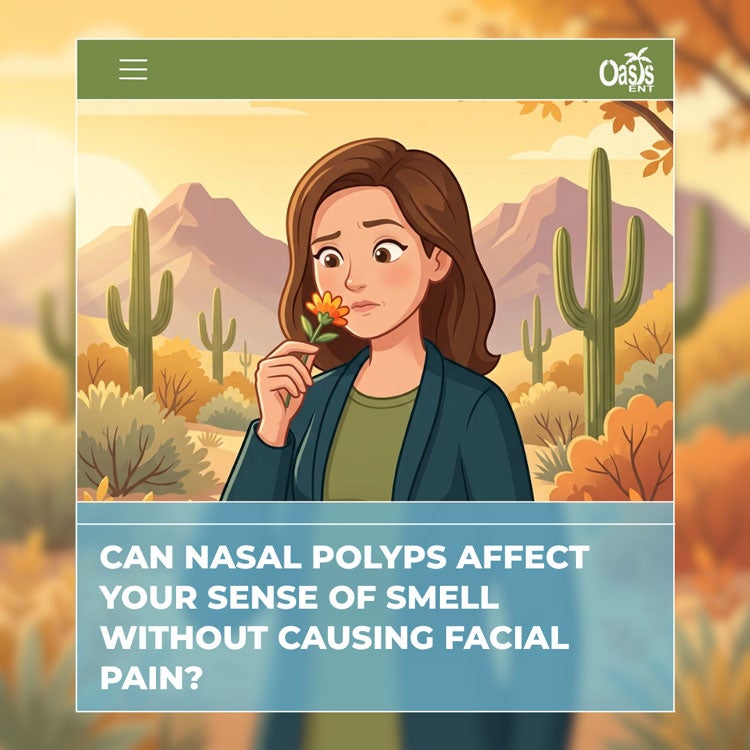
Can Nasal Polyps Affect Your Sense of Smell Without Causing Facial Pain?
Changes in your sense of smell can be confusing, especially when familiar scents become difficult to detect and your sense of smell does not seem to return to normal.
Several factors can contribute to smell changes. One possible cause is nasal polyps, which are soft, noncancerous growths that develop along the lining of the nose and sinuses. Depending on their size, location, and associated inflammation, nasal polyps may affect your ability to smell.
But can nasal polyps interfere with your sense of smell even when you are not experiencing facial pain or pressure?
Yes. Nasal polyps can affect your sense of smell without causing facial pain. In some cases, reduced smell may be one of the most noticeable symptoms.
At Oasis ENT, we help patients in Surprise, AZ, understand how nasal polyps may affect their sense of smell, why facial pain is not always present, and when an ENT evaluation may be appropriate.
What Are Nasal Polyps?
Nasal polyps are soft, painless, benign (noncancerous) growths that can develop along the lining of the nasal passages and sinuses.
They are commonly associated with chronic inflammation and often affect both sides of the nose, although the size and distribution of the growths can vary.
Small nasal polyps may cause few or no noticeable symptoms.
However, larger polyps or groups of polyps may contribute to nasal obstruction, interfere with sinus drainage, and affect the sense of smell.
Nasal polyps often have a teardrop-like appearance, while larger growths may resemble peeled grapes.
Although nasal polyps themselves are noncancerous, symptoms or growths affecting only one side of the nose may require further evaluation to rule out other conditions.
How Do Nasal Polyps Affect the Sense of Smell?
Nasal polyps may affect your sense of smell through more than one mechanism.
Nasal Polyps Can Restrict Airflow to the Smell Receptors
When nasal polyps become larger or occur in clusters, they may obstruct airflow through parts of the nasal cavity.
This can reduce the amount of air carrying odor molecules that reaches the olfactory region, which is located high inside the nose.
The olfactory region contains specialized receptors that detect odors and send signals to the brain.
When fewer odor molecules reach these receptors, your ability to detect familiar smells may decrease.
However, the degree of smell loss does not always correspond directly with how blocked your nose feels.
Chronic Inflammation May Affect Smell-Sensing Tissue
Chronic inflammation associated with nasal polyps may also affect the olfactory epithelium, the specialized tissue containing smell receptors.
This inflammation can interfere with odor detection even when nasal airflow is not significantly blocked.
As a result, some people may experience reduced smell without severe nasal congestion or facial pain.
Changes in smell may also fluctuate as inflammation changes over time.
Because several conditions can affect the sense of smell, a sudden, unexplained, or persistent change should be medically evaluated.
An ENT care provider can assess your symptoms and help determine whether nasal polyps or another underlying condition may be contributing.
Can Nasal Polyps Affect the Sense of Smell Without Causing Facial Pain?
Yes. Nasal polyps can reduce or alter your sense of smell without causing facial pain.
Smell changes may occur because polyps restrict airflow toward the olfactory region, because chronic inflammation affects smell-sensing tissue, or because both processes occur together.
Facial pain or pressure is not required for nasal polyps to be present.
Some people experience noticeable congestion and facial pressure, while others primarily notice a reduced sense of smell, postnasal drainage, or difficulty breathing through the nose.
The important distinction is that changes in smell can be a prominent symptom of nasal polyps even when facial pain is absent.
However, reduced smell alone does not confirm the presence of nasal polyps.
Other possible causes include respiratory infections, allergies, medication effects, and other inflammatory or neurological conditions.
An ENT evaluation can help identify possible contributing factors and determine whether additional testing is needed.
What Are the Symptoms of Nasal Polyps?
Symptoms of nasal polyps vary from person to person.
Small polyps may cause little or no noticeable discomfort. Larger polyps or more extensive inflammation may contribute to symptoms such as:
- Difficulty breathing through the nose
- Nasal congestion or obstruction
- Facial pressure or discomfort
- Reduced or lost sense of smell
- Reduced perception of flavor
- A runny nose
- Postnasal drip, or mucus draining down the back of the throat
- Headaches
- Snoring or disrupted sleep associated with nasal obstruction
Not everyone with nasal polyps experiences all these symptoms.
In particular, facial pain is not necessary for nasal polyps to affect the sense of smell.
Nasal polyps may also be associated with:
- Chronic or recurrent sinus inflammation and infections
- Asthma, which commonly coexists with chronic rhinosinusitis with nasal polyps
- Snoring or disrupted sleep when nasal obstruction is significant
Nasal polyps do not necessarily cause asthma attacks or sleep apnea.
Patients experiencing worsening asthma symptoms or signs of sleep apnea, such as repeated pauses in breathing during sleep, should receive an appropriate medical evaluation.
What Causes Nasal Polyps?
Healthcare professionals do not fully understand why some people develop nasal polyps while others do not.
However, nasal polyps are strongly associated with chronic inflammation of the nasal and sinus lining.
Several conditions may be associated with an increased likelihood of developing nasal polyps, including:
- Allergies
- Chronic sinusitis, particularly chronic rhinosinusitis with nasal polyps
- Asthma
- Cystic fibrosis
Not everyone with these conditions develops nasal polyps, and nasal polyps can also occur in people without these risk factors.
An ENT specialist can evaluate your symptoms, medical history, and examination findings to determine whether nasal polyps may be present.
How Are Nasal Polyps Treated?
Treatment for nasal polyps depends on several factors, including symptom severity, examination findings, the size and location of the polyps, response to previous treatment, and other individual health considerations.
Treatment may involve medications, surgery, or a combination of approaches.
Medications
Medications may help reduce inflammation and swelling in the nasal and sinus lining, which may improve symptoms associated with nasal polyps.
Depending on the patient’s condition, treatment options may include:
- Nasal saline sprays or rinses: May help clear mucus and support nasal hygiene, although they do not directly remove polyps.
- Intranasal corticosteroids: May help reduce inflammation and, in some patients, decrease polyp size.
- Short courses of oral corticosteroids: May be considered in selected cases to reduce significant inflammation, with potential side effects taken into account.
- Biologic medications: Treatments such as dupilumab may be appropriate for certain patients with inadequately controlled chronic rhinosinusitis with nasal polyps.
- Antibiotics: May be prescribed when a bacterial infection is suspected or confirmed, but they do not directly treat nasal polyps.
The effectiveness of treatment varies between patients.
An ENT specialist can discuss which medications may be appropriate based on the patient’s medical history, symptoms, and clinical findings.
Surgery
Surgery may be considered when nasal polyps continue to cause significant symptoms despite appropriate medical management or when other clinical findings support a surgical approach.
Potential procedures include the following.
Polypectomy
Polypectomy is a procedure used to surgically remove polyps.
For nasal polyps, an ENT surgeon may use specialized instruments and an endoscope to remove obstructing growths from the nasal cavity or sinuses.
The specific approach depends on the location and extent of the polyps.
Balloon Sinuplasty
Balloon sinuplasty is a procedure that may be considered for selected patients with certain sinus drainage problems.
It uses a small balloon catheter to widen a sinus drainage opening.
However, balloon sinuplasty does not remove nasal polyps or directly treat the underlying inflammation associated with nasal polyposis.
Balloon sinuplasty is not generally a primary treatment for nasal polyps.
If a patient has nasal polyps and a separate sinus drainage issue, an ENT specialist can determine whether balloon dilation has any appropriate role in the overall treatment plan.
Functional Endoscopic Sinus Surgery (FESS)
Functional endoscopic sinus surgery (FESS) uses an endoscope and specialized instruments to access the sinuses through the nasal passages.
Depending on the patient’s condition, the procedure may involve removing nasal polyps and other obstructing tissue, enlarging selected sinus openings, and improving access for ongoing medical treatment.
Surgical treatment may improve symptoms for some patients, but results vary.
Nasal polyps can recur even after treatment, including surgical removal.
Your ENT care provider may recommend ongoing medical management and follow-up care to help control inflammation and reduce the likelihood of recurrence.
When Is It Time to See an ENT Specialist for Nasal Polyps?
Consider scheduling an ENT appointment if you experience:
- Persistent nasal congestion
- A reduced or changing sense of smell
- Nasal or sinus symptoms that frequently return
- Symptoms that interfere with breathing, work, sleep, or daily comfort
- Postnasal drip that continues for several weeks
- Frequent throat clearing or a persistent cough
- Symptoms that do not improve with appropriate treatment
An ENT evaluation may help determine whether nasal polyps, another nasal condition, or a different underlying problem could be contributing to your symptoms.
When Should You Arrange Prompt Medical Evaluation?
Some symptoms should not automatically be attributed to nasal polyps.
Arrange prompt medical evaluation for:
- Sudden or unexplained loss of smell
- Persistent one-sided nasal obstruction
- Recurrent nosebleeds or persistent bloody nasal discharge
- New or unexplained facial numbness
- Persistent foul-smelling discharge from one side of the nose
- Significant or worsening facial pain or swelling
Nasal polyps commonly affect both sides of the nose. A persistent growth or obstruction affecting only one side may require further examination to exclude other conditions.
When Should You Seek Emergency Medical Attention?
Seek emergency medical attention for:
- Sudden vision changes or loss of vision
- Rapidly worsening swelling around the eye, particularly with pain or vision changes
- Severe headache accompanied by fever, neck stiffness, confusion, or other neurological symptoms
- Severe difficulty breathing or swallowing
These symptoms may indicate a condition requiring immediate assessment rather than routine nasal polyp evaluation.
Conclusion: When Your Sense of Smell Changes Without Facial Pain
Nasal polyps can affect your sense of smell even when you do not experience facial pain or pressure.
Smell changes may occur because polyps restrict airflow to the olfactory region, because chronic inflammation affects smell-sensing tissue, or because both factors are involved.
However, reduced smell does not automatically mean nasal polyps are present.
An ENT evaluation can help identify possible causes and determine whether medical treatment, additional testing, or another management approach may be appropriate.
Oasis ENT provides ear, nose, and throat care services for patients in Surprise, Sun City, Peoria, El Mirage, and nearby Arizona communities.
If you are experiencing persistent changes in your sense of smell, with or without other nasal or sinus symptoms, get in touch with our team to explore possible contributing factors and discuss treatment and management options based on your individual needs.
Results may vary: Treatment outcomes and health experiences may differ based on individual medical history, condition severity, and response to care.
Emergency Notice: If you are experiencing a medical emergency, call 911 or seek immediate medical attention.
Persistent nasal congestion, facial pressure, headaches, postnasal drip, and difficulty breathing through the nose can have several possible causes.…

Medically Reviewed and Approved by James Osborne, DO, FACOOS — September 22, 2026
Many people move to Arizona expecting to leave seasonal…